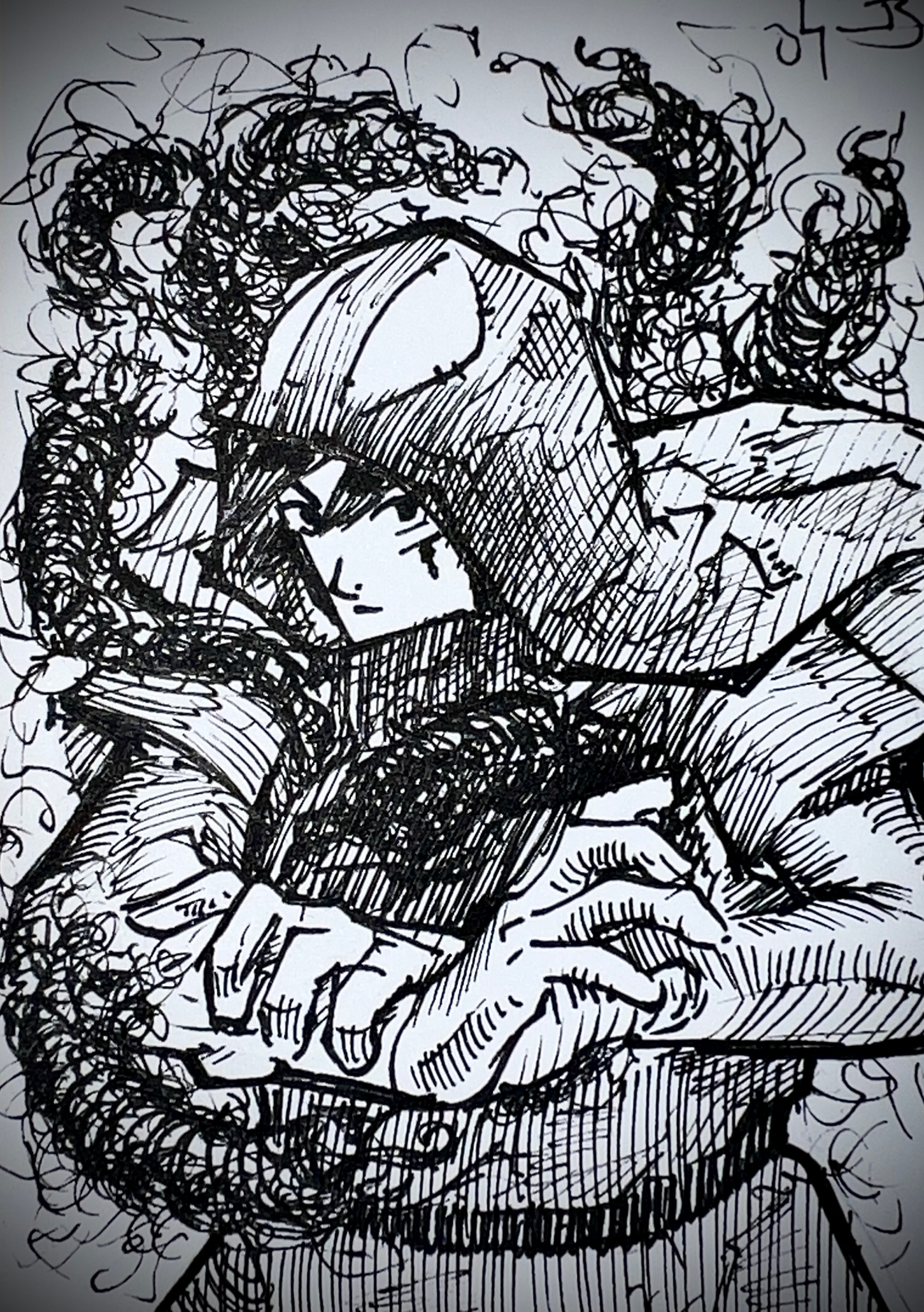
To “see with eyes unclouded by hate”…
When considering this line, I am reminded to view things from different points of views. Why do people feel so strongly one way or the other? Is it through some vindictive justice? A method of self preservation? To protect the ones around them? Or for personal gain?
Everyone has a reason for their stance. And while disagreements exist between the different factions, it does make me wonder how can we bring people together despite these ideological rifts.
We are constantly pulled one way or the other, being demanded to align. This becomes a social currency. Eventually, something sold (your values). A product to be advertised. Every side fighting for space saying why their view is more righteous.
This ideological declaration begs allegiance to the associated group, with limited deviation. Whether the groups be: political, social, religious, or tribes. To be accepted, your interiority must flatten to coincide with the group narrative, in ways that are intellectually dishonest. If you don’t align, you’re cast out. Not always as a punishment, but more as self preservation for the ideological framework.
Why are people who are thoughtful, nuanced, and internally consistent generally misunderstood, overlooked, and socially misaligned?

Presentation Gap
I’ll call this a “Presentation Gap”. The idea that we are an accumulation of experiences internally compared to the limited outward expression we choose to portray. And the larger that divide is, the more complex and ambiguous you become. This makes it harder to connect with larger social structures that have stricter guidelines for behaviors. Instead, it becomes something we manage individually.
The more nuanced your interiority is, the less legible you become to the world at large. The world demands explicit signals and ambiguity is difficult to categorize. This can be represented in examining how complex interiority interacts in context with strict social structures. In art, we can see this in the film Princess Mononoke.
Ashitaka from Princess Mononoke is a stoic young man. Refusing to engage in destruction despite the power he wields. No one knows whose side he is on, despite constantly outlining he doesn’t take sides. He has his own principles, and he applies them not to social groups, but rather to his identity and universal values.
But why is this constant friction in social scenarios? Are his principles not enough? At what point does he have to demonstrate his power to make himself heard or known?
Picking Sides
Most people don’t like ambiguity. Especially when it’s in social and relationship contexts where plausible deniability could create potential conflict in the dynamics.
Instead, you encounter the constant jeering of “Who’s side are you on?” that Ashitaka experienced when every conflict escalated. Only to see that he treats both sides equally.
There is a stronger power in not holding any particular side. By not aligning with any particular sect, you are able to stay closer to nuance than blind cohesion with the masses. It prevents dissolution when you are confronted with new truths and allows new opinions to form. But only as long as we remain flexible when we are presented new information.
When on a path like this, this internal clarity is required. But externally, it reads as ambiguous indecision. These assumptions will already categorize you, often as an antagonist for someone else’s goals, as we see in Princess Mononoke.
Constantly asking questions is integral for this position. Abandoning assumptions and looking for meaning. Not looking for vindication of my feelings in projecting my own morals onto large groups. Or even by assuming the worst or the best of others, unless I know them personally. But rather pushing myself to understand the context of a scenario, why something would happen, what the intentions are, and what the desired outcome is.
We need to discover the root cause of the problem, which we learn to be Lady Eboshi. The covert and political future problems that come with Jigo. And San who represents the righteous indignation. This triage of cause and effect brings us a better clarity to their conflict. That in a world of black and white, which operates in accordance to personal goals and vendettas, allegiance and nuance can’t coexist.
No Ego
Can we truly have an allegiance when we have conflicting contextual information? Or is emotional devotion integral to an idea our ultimate purpose, no matter how transgressive its other actions are?
These are the struggles Ashitaka, like us, faces when confronted with all of this information.
Ashitaka can’t align with anyone. But he understands everyone’s complicated position. He mediates between all of them. Allowing each to see the consequences of each of their objectives. He can allow his power to overcome the plot and eradicate the threats, but he allows them to be free agents.
Ashitaka is emotionally congruent. His purpose is to create cohesion between everyone. Yet this goes against every objective of the antagonists. And furthermore, he not only recognizes their transgressions, but uses them as signs for why not to trust their movements.
Diving deeper often helps with eliminating some of the preconceived notions and assumptions. Oftentimes, I find my initial view is incorrect, and the additional insight not only brings more nuance, but also makes it more intriguing. Making me question how things could be done better or differently if it created a massive backlash.
Even when you dive into the details, and tell others to change their thinking, they fundamentally are unable to. The preordinated assumptions and beliefs are not things we can change in others. That is a personal journey they have to overcome, which is why I choose not to attempt to persuade others to change their mind of their own foundational ideals. Because it demands a diminished ego most people can’t resonate with.
Lack of Alignment is Antagonist
Jigo and Lady Eboshi are prime examples of this. Leading their own groups of people, with their own plans that demand alignment to some degree. They are led by their own demons, or rather ego. Whether for their own personal gain or for the people they lead, they refuse to diminish their ego. And Ashitaka’s actions, no matter how worthy and demonstrative, are never able to convince them otherwise. Only until death was imminent and destruction had passed.
A ‘lack of action’ does lead to the classification of being an observer to some regard, but that is not to mean I am lacking in my own principles. I just have a different approach, mainly stemming from nurturing personal relationships and discovering actionable paths that can provide results. But the results must be clearly defined first.
This is why Ashitaka’s character doesn’t translate socially. Lady Eboshi, Jigo, and San all think that because he is not aligned with them, that he must be against them. But we see that’s not the case. Even when his demon arm attempts to grasp his sword to strike Lady Eboshi, who is the source of his own demon, he still restrains himself. He reasons it wouldn’t matter, that the killing wouldn’t stop. In this instance, both Ashitaka and Lady Eboshi acknowledge the ego she’s influenced on her town.
Different Dimensions
There’s the idea that who you are is different given the different social context. I categorize this as the embodiment of different dimensions we operate in our lives. Who you are when you are alone is different than at work, different with friends, and different with those intimate with you. Keeping the same throughline through all different dimensions.
Relationships in social contexts prefer legible allies. They create a compounding effect, and when dynamics become frustrated, they flatten. This disrupted norm creates friction and ambiguity between congruent characters.
Different Objectives
When San sees Ashitaka fail to negotiate between Lady Eboshi, Jigo, San, and the boar, this ambiguity makes Ashitaka’s position inconclusive to her, and she stabs him. The common theme of his illegible position being the catalyst to her action.
As we see in Princess Mononoke, the different leaders take difficulty in understanding the world beyond their own endeavors.
The boar filled with rage and hate sacrifices his tribe and himself into obliteration.
San is willing to lay her own life for the betterment of the forest. Which is admirable, but she does not have an identity or interiority beyond that vendetta.
At least when we see Lady Eboshi fall, we see her allegiance is still to her people. She’s willing to take a fall for the people she wants to protect. So while she has ideals that do hurt others, at least she has the instinct to protect her own.
Yet when we look at Jigo at his own moment to change, he says “Kid, listen, everybody wants to have everything in life, and now I might actually get it!”. With people who think like this, in letting other people do his dirty work, taking advantage of political and social scenarios through betrayal— how do characters like Ashitaka protect themselves against these antagonists?
What we learn is that people like Jigo don’t care about what happens to people around him.
He only cares about his own accomplishments. And using others and weaponizing their ambiguity to get there.
Who is Jigo?
Do we see people who use this tactic for their own advancement? These people don’t make their methods known until after their plan is being carried into action. They use ambiguity to their advantage. These types of individuals, as characterized in the film, are extremely dangerous. They don’t represent the common goal. They seek ‘friendships’ with anyone who has the propensity to benefit others, including themselves.
We can see it’s very difficult to exercise soft skills from complex hierarchical structures because it requires a foundational level of commonality, both socially and objectively.
One of the most interesting things is to navigate these dynamics. Seeing who are trustworthy people versus those who are the type to abuse such structures for their own gain. Everyone has their own personal objectives, but finding commonality is an invigorating objective to accomplish.
I use this as an example, because it’s readily applied to other social contexts, and is more relatable and easily identifiable.
We see how Ashitaka prioritizes social balance as he negotiates between Lady Eboshi and San when San infiltrates the town. Both the humans and San lash out and hurt Ashitaka. The risks of engagement left no one unscathed.

Complex Interiority
Ashitaka’s example for not aligning doesn’t read as a sign of wisdom, but rather evasiveness. But seeing the story through Ashitaka, we know he is anything but evasive. The constant juggling of conflicting desires and sacrifices, pleading with opposing political characters while struggling with his own demon. Only to consistently lose. Yet maintains his principles.
When people demand alignment, nuance becomes a sign of incompatibility and incongruence. And most people can’t regulate that within an existing systems framework.
The social contexts of each situation can complicate how you’re viewed in the different scenarios, particularly when your different personalities cross over each other.
The more complex your interiority becomes, the more intentional you have to be in how you present it. And it must also be presented with some level of guarded protection.
Not everyone will treat vulnerability with understanding.
Leave a Reply